The Hidden World of Dry Stone Walls

What Do Dry Stone Walls Really Mean?
Dry stone walls are among the most enduring and geographically widespread forms of human landscape modification. Constructed without mortar and relying on the careful positioning of stone, they appear across many different environments, from the uplands of northern England to the terraced slopes of the Mediterranean, even the mountains of the Andes. Their physical simplicity belies a remarkable cultural complexity. While their practical functions in agriculture and land management are well documented, their symbolic, cultural, mythological and folklore features remain comparatively underexplored.
In recent decades, landscape archaeology, cultural geography, and the environmental humanities have reframed dry stone walls as cultural landscapes, with the structures reflecting long-term interactions between mankind and the natural environment[i]. Dry stone construction is now on the UNESCO Representative List of the Intangible Cultural Heritage of Humanity[ii]. Dry stone walls are thus not merely physical artefacts but carriers of meaning. They follow boundaries, embody labour, support ecological systems, and act as repositories of memory.
They are also surrounded by mythology and folklore - both are frequently underestimated - and especially so in Cumbria’s Lake District.
First, of course, there is a question. What is the difference between mythology and folklore? After all, I tend to use the words interchangeably. The purists say there is indeed a difference. In outline, mythology consists of sacred, traditional narratives that explain cosmic origins, deities, and natural phenomena. On this basis, mythology often underpins beliefs. Folklore, meanwhile, encompasses a broader range of cultural traditions, including legends, folktales, superstitions, and songs. It often focuses on daily life or moral lessons.
While myths are often seen as true within their culture, folklore is usually for entertainment or community tradition. So, the purists are right. There is a difference between the two.
Walls That Shape the Land
Dry stone walls are integral elements of so-called cultural landscapes. These are defined as environments shaped by the combined action of natural processes and human activity over time[iii]. Such landscapes are increasingly recognised as heritage systems, and reflect accumulated knowledge, adaptation, and cultural expression[iv].
The dry stone walls of the Lake District are central to both the physical and cultural identity of the region. They form an intricate network of boundaries that structure the landscape, delineate fields, guide livestock, and shape patterns of movement. Many of these walls were constructed during the period of parliamentary enclosure in earlier centuries, when common land was systematically divided into privately owned parcels[v]. This transformation altered not only land ownership but also the social and cultural fabric of rural communities.
The British enclosure movement[vi], which privatised common land into individually owned fields, began as early as the 12th century. There were further major waves between 1450 and 1640, and a peak of parliamentary enclosure between 1750 and 1860. It had ended by the late 19th century. In Cumbria, the enclosure movement represented a critical moment in the history of dry stone walls. The enclosure movement was driven by a push for agricultural efficiency but resulted in the loss of common land for many peasants.

The phases were:
1. Early Enclosure (12th-15th Century)
Initial, often informal, consolidation of strips of land began as early as 1235 after the Statute of Merton. The Statute of Merton (1235) was the first statute enacted during Henry III's reign and one of the earliest recorded Acts of Parliament in England. It covered topics such as bastardy, inheritance, and land use, and allowed lords to enclose common land if sufficient pasture remained for tenants.
2. Tudor/Early Modern Period (1450-1640) Landowners heavily converted arable land into sheep pasture, thereby accelerating enclosure. This was essentially the wool era for the UK. It was most dominant in England, with wool being the backbone of the English economy. It was often referred to as "the jewel in the realm" or "white gold," and drove both agricultural production and international trade.
3. Parliamentary Enclosure (1750-1860) This was the most intense period, when over 5000 acts of Parliament were passed to privatise land, drastically changing agricultural practices and rural society. Roughly 21% of England's land area was reorganised. Landowners aimed to improve productivity, implement new farming methods, and consolidate scattered, inefficient strips of land. While it increased agricultural output, the reorganisation hit the rural poor the hardest. Smallholders often could not afford to fence their new allotments, forcing them to sell to larger owners. There was significant resistance, including petitions against the acts, but the process was heavily biased toward large, landed interests.
4. The End: By the mid-19th century, the enclosure movement was largely complete. The 1876 Commons Act effectively ended the systematic enclosure of common lands.
The spatial arrangement of dry stone walls reflected both the environmental constraints and human decisions. Traditional landscapes were characterised by these patterns, and this character persists to this day, at least in part. In Cumbria, walls often followed contours, avoided unstable ground, and integrated with natural features such as streams, isolated boulders, and rocky outcrops. This integration created a landscape that appeared both ordered and organic.
Globally, similar systems can be seen. The technique of dry stone walling was widely used, although the specifics of the technique varied from one place to another. For example, dry stone walling in Cumbria is different to that seen in the Cotswolds, while France is different to Greece, or South Korea is different to the Andes. In Mediterranean regions, terraced walls enabled cultivation on steep slopes and transformed marginal land into a productive agricultural system[vii]. Stone-built field systems reflected the adaptation to local environmental conditions.
Dry stone walls are thus not isolated phenomena but part of a broader human tradition of shaping land through stone. They are embedded within cultural landscapes and are evidence of both practical knowledge and symbolic meaning. They are expressions of social organisation and reflect ownership, control, and identity.
Who Owns the Land, and Who Decides?
At their most basic level, dry stone walls define boundaries. They separate spaces, regulate access, and enforce systems of ownership.
Enclosure, once it was enforced, imposed a new spatial order, and replaced communal systems of land use with individually owned and managed parcels of land. Walls became the physical manifestation of this transformation and marked the transition from shared to private landscapes.

This process had profound social implications. It altered patterns of labour, disrupted traditional practices, and redefined relationships between the people and the land. The wall, therefore, carried a dual symbolism. It represented both the imposition of order and the loss of communal systems. Landscape was not merely a physical entity but a reflection of how cultural values and social structures were shaped[viii]. Boundaries played a central role in this process.
It is no surprise then, that dry stone walls give a sense of place and pride. It is no wonder that they are also associated with mythology and folklore.
Where One World Becomes Another
One of the most persistent themes in the mythology of boundaries is liminality. Liminal spaces are zones of transition, where normal structures are suspended, and transformation becomes possible[ix].
Dry stone walls occupy a uniquely liminal position within the landscape. They mark the edges of fields and territories, yet they are inherently permeable. Their construction allows the passage of air, water, and small organisms, creating a form of soft boundary. This permeability distinguishes them from solid barriers and reinforces their role as interfaces rather than absolute divisions. A good way to see this in Lakeland is during one of the many heavy rainstorms. A dry stone wall can turn into a horizontal shower. On one occasion, I saw a fish (pike) that had been forced into an aquifer by the broad lake below. Out of the aquifer it popped, only to encounter a dry stone wall, through which it flopped. It then sadly perished on the far side of the wall, but was nevertheless a perfect example of porosity.
Landscapes are continually altered through human activity[x]. Boundaries, including walls, are therefore dynamic features, embedded within the ongoing interactions between people and the environment. They are not fixed lines but evolving elements of the landscape.
In folklore and cultural tradition, boundaries are frequently associated with encounters with the supernatural. The act of dividing space creates zones of transition that acquire symbolic meaning.
In Cumbria, where walls cross open fells and remote valleys, their presence contributes to a sense of threshold between cultivated and uncultivated land, between human control and natural processes. This liminal quality underpins their mythological significance.
The Cumbrian Wall and Its Makers
The dry stone walls of Cumbria are distinguished by their close integration with the local environment. Constructed from locally sourced stone, they reflect the region's geology. This makes them appear to be natural extensions of the landscape. Yet they are anything but natural.
The construction of a dry stone wall requires considerable skill. Dry stone walling is a craft that depends on an understanding of stone properties, structural stability, and environmental conditions. There is considerable technical sophistication involved in achieving durable structures without mortar[xi]. When building a dry stone wall, the waller should aim to make it last for at least a century. That is not always easy.

The technique a waller uses contributes to the region's cultural identity. Wallers are custodians of specialised knowledge, and their work embodies a long tradition of interaction with the landscape. The wall itself becomes a record of this labour.
Stone Walls Across the World
While the forms of dry stone wall can vary throughout the world, common themes of permanence, boundary, and cosmology recur.
For example, in Mediterranean regions, terrace walls are widely recognised as examples of traditional agricultural systems. They have great cultural and ecological significance and represent long-term adaptations to challenging environments. Their abandonment can lead to soil degradation and increased erosion. There is a delicate balance between human intervention and environmental stability.
Meanwhile, in the Andes, stone construction is closely linked to cosmological beliefs. Inca stonework, for example, reflected both technical expertise and symbolic meaning, with structures often being aligned to natural and celestial features[xii]. These constructions embodied a worldview in which human and environmental systems were interconnected. A well-documented example can be found at Machu Picchu, where architectural elements are deliberately orientated towards surrounding mountain peaks that were themselves regarded as sacred entities. The Intihuatana stone, frequently interpreted as a ritual device associated with solar observation, appears to have been positioned relative to the sun's annual movement, particularly at the solstices. Similarly, at Coricancha, the principal temple of the sun in Cusco, wall alignments and window placements have been shown to correspond with solar events. These examples illustrate how Inca stone construction was a material expression of a worldview in which landscape, astronomy, and political authority were closely intertwined.
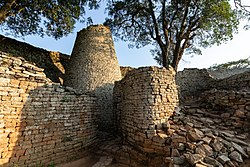
In sub-Saharan Africa, stone-built complexes such as Great Zimbabwe illustrated the role of architecture in expressing social and political identity. Such structures were associated with authority, continuity, and ancestral presence[xiii]. A clear example is the spatial separation between the Hill Complex and the Great Enclosure of Great Zimbabwe. The Hill Complex, situated on elevated ground, is widely interpreted as an early seat of authority, its position reinforcing both visibility and symbolic dominance over the surrounding landscape. By contrast, the Great Enclosure, with its massive dry stone walls - some exceeding 10 metres in height and constructed without mortar - appears to have functioned as a centre of elite residence or ceremonial activity. Access to these areas was likely controlled at the time. The initial settlement of Great Zimbabwe was 900-1100CE, while its peak occupation and political importance were 1100-1450CE. It declined after that. At its height, it was the centre of a powerful state engaged in long-distance trade, including connections with the Swahili Coast and beyond.
Stone structures thus serve as more than functional solutions. They are embedded within systems of belief and meaning, and link human activity to broader cultural and cosmological frameworks. Dry stone walls participate in this global tradition and reflect shared human concerns with boundary, permanence, and identity.
The Hidden Life Inside a Wall
Dry stone walls are increasingly recognised as important ecological features. Their structure creates a range of microhabitats, supporting diverse communities of organisms. Stone surfaces support lichens and higher plants[xiv], while broader studies of stone ecology highlight the interactions between biological and physical processes[xv]. These microhabitats contribute to biodiversity by providing shelter, nesting sites, and corridors for movement. These have been described as vertical ecosystems, emphasising the capacity of dry stone walls to support life in many ways[xvi].
In upland environments such as Cumbria, this ecological function is particularly significant. Walls create sheltered niches in otherwise exposed conditions, and support species adapted to microclimatic variation. They also contribute to landscape connectivity and facilitate the movement of organisms between habitats.
This ecological dimension reinforces the symbolic significance of dry stone walls. They become living structures, integrating human construction with natural processes. Their mythology is thus not only cultural but also ecological, reflecting the interconnectedness of human and non-human systems.
The Work Behind the Wall
The construction and maintenance of dry stone walls are labour-intensive processes that require both physical effort and technical knowledge. I have at least six kilometres of dry stone wall on my land and patrol it regularly. It is far better to correct a slip here or a small area of collapse there, than to spend much longer on a formal wall repair from bottom to top. This so-called taskscape provides a useful framework for understanding the landscape. Rather than viewing landscapes as static features, both activity and practice shape the environment. In simple terms, landscape is what is seen (e.g., fields, walls, trees), while taskscape is what people do there (e.g., building, farming, repairing, walking).
Dry stone walls are products of the taskscape. They embody the accumulated labour of individuals and communities and reflect the ongoing processes of construction, repair, and adaptation. This contributes to their cultural significance and positions them as symbols of endurance and resilience.
In many regions, walling traditions are maintained through apprenticeship and community practice. I host occasional volunteer days on my land, where beginner wallers from throughout the country come to learn what was once a commonplace technique but is now fading. The volunteers also learn or overhear plenty of stories, which they then share with their friends, colleagues, and family. This continuity reinforces the connection between landscape and identity, and links present-day activities with historical traditions.
What Walls Remember
One of the most striking features of dry stone walls is their durability. Unlike many other forms of construction, they can persist for centuries with minimal maintenance. This longevity positions them as repositories of memory. I am often saddened when I repair a wall yet find no sign of those who were there before me. I make sure to carve a small stone with the date and my name whenever I undertake a repair. I leave the carved stone deep within the wall, as one day, someone will follow me. By then, I will be long gone, but the wall should still be standing.
In cultural geography, dry stone walls are seen as elements of so-called memory landscapes, where physical structures anchor collective memory. Dry stone walls, with their visibility and permanence, serve this function particularly effectively.

In Cumbria, walls often incorporate stones that have been reused over generations. This reuse creates a layered landscape, in which successive phases of human activity are embedded within the same structure. The wall stands quietly, innocent almost, and records the history of interaction between people and land. To repair a wall is also to learn something of its history. Walls tend to fail in the same place, time after time. I frequently take a shovel with me when repairing a wall, to unearth the stone that fell there many years ago. I often find more stone than I need, as so much has fallen over the centuries.
Stories the Walls Still Tell
There are many themes for the folklore of dry stone walls. These commonly include:
Boundary between worlds (fairy realm versus humans)
Placed stones as sentient or enchanted
Cursed or haunted walls
Walls built by giants, spirits, gods, or heroes
Walls that move or rebuild themselves
Walls created as penance or punishment
Walls marking sacred or supernatural spaces (burial grounds, holy sites)
Walls connected to weather, fertility, and protection magic
Across many cultures, dry stone walls are more than infrastructure - they are thresholds, and often implicitly supernatural.
Wall Myths Around the World
1. British Isles (England, Scotland, Wales, Ireland)
a. Fairy Walls (England and Ireland)
In many rural areas, especially Cumbria, Yorkshire, and the West of Ireland, old dry stone walls are believed to follow ancient fairy paths. Disturbing such walls is said to bring misfortune, illness, or inexplicable problems with livestock. A common saying is, “Do not rebuild a fallen wall too hastily; the old spirits use the gaps.” I must remember that, as I spend lengthy periods repairing fallen walls.
b. The "Shining Walls" of the Lakes
Local Cumbrian folklore (scattered in oral tradition and local antiquarian texts) speaks of walls that shine at dusk, believed to be the spirits of those who built them - a kind of ancestral presence marking territory and memory.
c. The Giant-Built Walls (Scotland)
Many drystone enclosures are attributed to giants - a catch-all explanation for very large or unusually well-constructed prehistoric walls. Variants exist in Skye, Orkney, and the Highlands. In Cumbria, it is said by some that the walls with the largest stones at their base are the oldest. I am unsure if that is correct. Some of the stones are huge, however, and it is a wonder how they got there.
d. The Curse of the Shattered Wall (Wales)
Welsh folklore contains recurring accounts of dry stone sheepfolds that refuse to stand. Walls are built, repaired, and rebuilt, yet each time they collapse without obvious cause. These failures are often attributed not to poor workmanship but to the presence of a disturbed spirit, believed to guard an older, sacred burial site beneath or within the enclosure. In such stories, the act of walling is not neutral. It becomes an intrusion upon a pre-existing moral landscape, where the dead retain a form of agency and memory, and where enclosure is quietly but persistently resisted.
2. Mediterranean and Balkans
a. The Cyclopean Walls (Greece and the Balkans)
Massive prehistoric drystone fortifications - Mycenae, Tiryns, parts of Epirus - were explained by the ancients as being works of Cyclopes, as no human could move stones so large. The term Cyclopean masonry persists archaeologically as a consequence.

b. The Romanian “Sântoader Walls”
Named after supernatural beings similar to fairies, these walls were considered liminal boundaries. Crossing them at night was taboo because the Sântoader were believed to travel along them as shining apparitions.
3. Middle East
a. Djinn Walls
Unmortared stone enclosures in remote deserts were said to be built by djinn, either as markers of territory or prisons for wayward spirits. Removing a stone could release something unpleasant. Djinn were supernatural, intelligent spirits in Islamic theology and Arabian mythology. They existed in a parallel world and possessed free will, allowing them to be good, evil, or neutral. They could also influence humans. They could shapeshift, too, appearing as humans or animals.
b. The Wall of Uzza (Levantine tradition)
In parts of pre-Islamic Arabia, certain drystone barriers and boundary markers were associated with the goddess Uzza, who was regarded as a protector of oases, routes, and those moving between them. These low stone constructions were not merely functional divisions of space but were understood to carry a protective presence. Travellers and shepherds, conscious of the uncertainties of desert movement, would place small offerings into the crevices of the stonework. Shells, beads, and other portable objects served as quiet acts of acknowledgement, marking both gratitude for safe passage and a request for continued protection.
4. Sub-Saharan Africa
a. Great Zimbabwe and the "Sung Builders"
Although Great Zimbabwe is not strictly dry stone in the Lake District sense, it is dry-laid, and mythologically attributed to demons, vanished civilisations, and guardian spirits of the land. It is central to Shona cosmology, and its walls are believed to channel spiritual power.
b. The Stone Fences of the Dogon (Mali)
Dry stone structures around villages were mythically associated with Nommo, the amphibious primordial beings. They marked sacred order and metaphysical geometry. The Dogon are an ethnic group living primarily in central Mali, best known for their distinctive cliffside settlements along the Bandiagara Escarpment. Their population is typically estimated at up to one million people.
5. North America
a. The “Spirit Walls” of the Navajo and Apache
Among the Navajo and Apache, certain stone alignments and low wall-like features have been interpreted as carrying meanings beyond their immediate practical use. While some clearly served to guide movement, manage animals, or structure space, others appear to have marked areas of ceremonial or social significance. Stone arrangements may have been understood as helping to define safe space, to delineate areas of ritual activity, or to mediate the presence of harmful forces.
b. New England “Witch Walls”
In some Puritan communities, farmers attributed inexplicable collapses of dry stone walls to witches. A few walls were deliberately built with “witch stones”, which were oddly shaped stones with natural holes, to protect livestock.
6. Oceania
a. Rapa Nui (Easter Island)
On Rapa Nui, the dry stone ahu platforms that support the moai statues formed an integral part of a wider ancestral landscape. These carefully constructed stone terraces were not simply structural foundations but were understood as embodying lineage and presence. In Rapa Nui belief, ancestors retained an active role in the living world, and both the ahu and the moai contributed to this continuity. The concept of mana, often translated as spiritual potency or authority, was associated not only with the statues but with the stones themselves. The integrity of the platform mattered. Disturbance, collapse, or displacement of stones was not merely architectural damage but a disruption of ancestral power.
b. Māori "Pā Walls"
Some drystone constructions forming parts of fortified pā were attributed mythologically to the Patupaiarehe, pale forest-dwelling spirits who worked only at night. A fortified pā is a traditional Māori defensive settlement, typically built on elevated ground, using terraces, deep ditches, and wooden palisades for protection.
7. East Asia
a. Japan: The Self-Repairing Walls of Okinawa
In the Okinawa archipelago, traditional stone walls constructed from locally quarried limestone have long been associated with ideas of continuity, ancestry, and respect. Within the cultural framework of the former Ryukyu Kingdom, where ancestral veneration and the presence of spirits within the landscape remain significant, such walls were sometimes understood to reflect the moral state of those who built or maintained them. Oral traditions suggest that well-treated walls, constructed with care and proper regard for ancestors, would endure with minimal intervention, whereas those associated with neglect or disrespect might repeatedly fail, requiring continual repair.
In addition, certain sacred sites, particularly near utaki (holy groves), were said to incorporate stones regarded as receptive or responsive. These so-called listening stones were believed to register prayer, intention, or disturbance, reinforcing the idea that the wall itself could participate in the spiritual life of the community.
b. Korea: The Ghost-Walled Villages
Dry stone boundary walls around villages were said to keep out gwishin (restless ghosts). Their positioning followed geomancers’ advice on spiritual flow. A geomancer is a person who practices geomancy, which is a method of divination that interprets markings on the ground, patterns formed by tossed handfuls of soil, rocks, or sand, or natural geographic features.
The Fair Folk of the Wall
If there was ever a doubt about the mythology and folklore of dry stone walls, I need only think of what happened to me. It was entirely unexpected. I was walking across my land, patrolling my boundary walls to check for fallen stones, the light was fading, and night was beginning to fall. Then something happened that, however much I try, I find impossible to explain. I tell this story to children, and to adults, indeed to anyone who might listen. They are fascinated, I am fascinated, as it truly did happen.

Imagine, first, that we are standing beside each other on the fellside, by some fluke it is not raining, the fading light is around us, and far in the valley bottom, some streetlights have just been turned on. It is a time for stories, plenty of them. Mine goes as follows:
When people ask me whether there are fairies on this land, I no longer dodge the question.
Yes, I do believe there are. Not in the glitter-and-gauze sense. Not as decorations for children’s books. But as presences that belong to margins - to edges, to transitions, to places that are neither entirely one thing nor entirely another. And this land is full of such places.
Look at this wall. The one right here.
On one side, slightly down the hill, is woodland recovering itself - hazel thickening, oak pushing up through what used to be close-grazed turf. On the other side is open fell, wind-shaped and uncompromising. The wall runs between them, almost like a quiet agreement.
Dry stone walls are peculiar structures. They look solid, yet they breathe. They keep sheep out, but voles pass through. They divide land, but they are made entirely from the land they divide.
In Cumbria, fair folk have always preferred the margins - hollows in hills, narrow rock steps, cave mouths, places where light changes quickly. For example, there is a tradition at the Fairy Steps near Beetham, less than 35 kilometres to the south of this wall. Climb its narrow rock steps without touching the rock that surrounds them, and your wish is granted. Touch the sides, and it is not. The rule is simple, but it implies something larger. Certain thresholds are shared.
Now, down the slope from this wall, and barely a few hundred metres distant, are some old quarry scars. It is there that you will see where stone was taken from this hillside long ago. Largely slate. Much of nearby Ambleside town was built from this slate.

These cuts, the occasional dynamite explosion, must once have felt like human triumph. Extraction. Improvement. Control. Even profit. There was once a time when humankind was all over this place. Right here. Albeit at least 100 years ago.
But the woodland is now slowly taking the quarries back. Moss softens the edges. Saplings stitch the wound closed. The land heals quietly, without drama.
Further along this wall is a collapsed sheepfold. Once it gathered animals tightly and efficiently. Now it holds ferns and wrens and rainwater. It has moved from control to openness.
I believe the fair folk prefer it that way.
I decided when I began working here that nothing powered by fossil fuels would operate on this land. No petrol engines. No diesel machinery. Work is done by hand, by batteries charged elsewhere, or not at all.
Some people find that eccentric. Others find it pathfinding. Others do not understand.
But when you remove the engines, something changes. You begin to hear the wall - not metaphorically, but physically. The tiny movements within it. The wind threading through it. The life it shelters. And you become aware that this boundary, this wall, is not empty space.
I had an experience here one autumn evening that confirmed my belief.
It was just after dusk. The woodland darkened more quickly than the fell, and the wall was holding the last of the day’s warmth. I was walking along near the bend by the old sheepfold when I saw a figure standing on the wall ahead of me.
Small. Upright. Very still. Was it a tiny lady, perhaps? I cannot be sure.
Certainly, it was not a sheep. Not a fox. Not a trick of peripheral vision. It was there - distinct against the fading light.
I stopped.
For several seconds, we regarded one another. The figure looked at me, and I looked at it. Her, him, something, I cannot be sure.
I cannot describe it better than that.
There was no fear. No drama. Simply recognition.
Then, as gently as mist lifting, it was gone. Not running. Not darting. Simply no longer there.
You may decide that this was a shadow and imagination. I have considered that carefully.
But what I know is this - since I stopped forcing this land, since I reduced grazing pressure, since I refused engines and allowed woodland to return, the atmosphere here has altered.
It feels inhabited. Not haunted. Not theatrical. Shared.
The fair folk, as they have long been understood in northern tradition, are not separate from land. They are expressions of its aliveness. They appear where we pay attention and where we tread carefully.
And this wall - running between regeneration and exposure, between past use and future intention - is precisely the kind of place they would choose. I was not surprised. Nor I suspect, was the fleeting figure.
If you stand here quietly, you may feel it.
Not something dramatic. Just a subtle quickening at the edge of perception.
That is enough.
I do not claim proof. I do not offer evidence in a laboratory or scientific sense. But I believe that when a piece of land is treated with restraint - when quarry scars are allowed to heal, when sheepfolds become circles of shelter rather than control, when walls are repaired by hand rather than machine - the fair folk approve.
And sometimes, if you are very fortunate, they allow you to see them. Only briefly. Just long enough to remind you that you are not the sole custodian of the boundary, whatever it may be.
You are simply part of a life that is forever moving onwards. There is plenty about that life that you do not, indeed will not, ever understand.
That fleeting figure? I truly do not know. But I do know that I saw it.
Why These Walls Still Matter
It is safe to conclude that dry stone walls are far more than functional structures. They are cultural artefacts, ecological systems, and symbolic forms that reflect fundamental aspects of human engagement with the environment. They can also be home to fairies. I now know that for a fact. From Cumbria to the Mediterranean, Africa, the Far East and beyond, they embody processes of boundary-making, labour, memory, and the supernatural.

Their mythology and folklore arise from their complexity. Walls are both barriers and thresholds, separating and connecting, static and dynamic. They define space while remaining permeable, supporting both human and ecological systems.
In Cumbria, these themes are particularly evident. The dry stone walls of the Lake District are integral to the landscape, took a long time to construct, and shape both the countryside’s physical form and its cultural meaning. Globally, similar structures reveal shared patterns of human interaction with stone and land.
In an era of rapid change, dry stone walls offer a powerful reminder of continuity. They demonstrate how human interventions can endure, acquire meaning over time, and how, as humans, we think we understand so much, when we comprehend so little.
Dry stone walls remain central not only to the history of landscapes but to their ongoing mythology and folklore.
Just ask a passing fairy. You will find one, likely unexpectedly. It is important not to search. You see, fairies do exist, but they hate being hunted.
***
Hashtags
#DryStoneWalls #LakeDistrict #Cumbria #StoneWalling #CulturalLandscape #WallFolklore #LandscapeHistory #Rewilding #TheBitOutside #EnvironmentalWriting
***
References
[i] Antrop M. Landscape change and the urbanization process in Europe. Landscape Urban Plan. 2004;67(1–4):9–26.
[ii] UNESCO. Art of dry stone construction, knowledge and techniques. See https://ich.unesco.org/en/RL/art-of-dry stone-construction-knowledge-and-techniques-02106. Accessed 4 April 2026.
[iii] Agnoletti M. The Conservation of Cultural Landscapes (CAB International), 2006.
[iv] UNESCO. Operational Guidelines for the Implementation of the World Heritage Convention. Paris: UNESCO; 2021.
[v] Mingay GE. Parliamentary Enclosure in England. London: Longman; 1997.
[vi] Wikipedia. Enclosure. See https://en.wikipedia.org/wiki/Enclosure. Accessed 4 April 2026.
[vii] Tarolli P, Preti F, Romano N. Terraced landscapes: soil degradation risks. Anthropocene. 2014;6:10–25.
[viii] Cosgrove D. Landscape and the European sense of sight-eye. Trans Inst Br Geogr. 1985;10(1):45–62.
[ix] Turner V. The Ritual Process. Chicago: Aldine; 1969.
[x] Ingold T. The temporality of the landscape. World Archaeology. 1993;25(2):152–174.
[xi] Brunskill RW. Dry Stone Walling. London: Batsford; 1994.
[xii] Protzen JP, Nair S. The Stones of Tiahuanaco. Los Angeles: Cotsen Institute; 2013.
[xiii] Pikirayi I. The Zimbabwe Culture. Walnut Creek: AltaMira Press; 2001.
[xiv] Lisci M, Monte M, Pacini E. Lichens and higher plants on stone. Int Biodeterior Biodegradation. 2003;51(1):1–17.
[xv] Caneva G, Nugari MP, Salvadori O. Plant Biology for Cultural Heritage. Los Angeles: Getty; 2008.
[xvi] Francis RA. Wall ecology: a frontier for biodiversity. Prog Phys Geogr. 2011;35(1):43–63.


Comments