How to Plant a Tree That Survives
Why establishment matters more than planting
Fallen tubes
From my land in the Lake District, I can see them scattered across the opposite slope.
Hundreds of them. Plastic tree tubes lying flat in the grass, bracken, or heather. Most of the trees that once stood inside them are now dead. They look depressing, as their now-supine position suggests they have been ignored. They definitely appear unloved.

At first glance, they look like the remains of some small encampment after a storm. Pale cylinders lying flattened in the grass. Some lean sideways at improbable angles. Others have collapsed completely, their plastic walls twisted by wind, rain, sheep, cattle, deer, or plain neglect. Inside each tree tube, there was once a sapling. Many of those saplings are now dead.
When the wind rises, the tubes rattle faintly against their stakes. At least those stakes that remain unbroken. The sound carries across the valley on quiet mornings. It is not loud, and it is not dramatic. Yet it is unmistakable. It is the sound of a good intention that did not become a living landscape, which was somebody’s original intention.
The trees were planted only a few years ago. Volunteers, most likely, who had probably arrived with enthusiasm, spades, and bundles of young trees wrapped in damp packaging. Someone may have made a short speech about restoring nature. Photographs were likely taken. They would have shown muddy boots, smiling faces, and a hopeful line of thin saplings stretching across the fellside. Then the planters went home, leaving the tubes and newly planted trees behind.
Some trees survived. Many did not.
Looking across the valley beneath me, it is difficult not to think about how odd our modern conversation about trees has become. We speak constantly about planting trees. Governments announce the number of trees they intend to plant. Charities publish figures showing how many saplings they have planted. Companies sponsor planting days and issue cheerful reports. Social media is filled with images of people holding spades beside a newly planted whip. As best I can tell, whenever royalty goes anywhere, they always plant a tree, smiling into a camera, while looking proud. All of this has a certain energy to it, and much of it is well meant.
But what is discussed far less is establishment. Yet this is the part that decides whether the act of planting meant anything at all.
A planted tree that dies after one winter is not a woodland in waiting. It is a failed beginning. A planted tree that survives, roots deeply, resists weather, avoids being gnawed, and begins to shape the soil and the air around it is something different. That tree has crossed the line between gesture and reality.
This distinction matters. We live in an age that admires visible interventions. Planting is visible. Establishment is slow, quiet, easy to overlook, and frequently ignored. Planting can be counted on the day. Establishment can only be judged later. Planting produces an image. Establishment produces a future.
That is why so many slopes are now dotted with the pale remains of failed optimism. The photograph was taken. The sapling went in. The tube stood upright. Then, weather, soil, herbivores, poor staking, waterlogging, neglect, or a hundred smaller failures did their work. The countryside keeps the evidence. As do I, now that I have become a fellside environmentalist.
Planting is easy
Planting a tree is simple. Or so it is said.
Dig a hole. Insert the tree, however big or small it may be. Replace the soil. Press it down (tamp) with your boot. Stand back and admire. The whole process may take only a few minutes.

It feels complete. Something visible has happened. A tree stands in the ground where before there was only grass, bracken, or rough pasture. That sense of completion is deeply seductive and helps explain why planting dominates the public imagination. It offers a neat story with a beginning, a middle, and an end.
But the truth is less tidy. The planting itself represents only a small fraction of the labour and attention required to bring a tree successfully into the landscape. Most of the real work begins after the spade has been set aside. If I were forced to put numbers on it, planting might amount to 10% of the whole task. The remaining 90% is establishment.
Establishment means roots growing into the surrounding soil. It means the tree surviving transplant shock. It means avoiding drought but also avoiding drowning. It means deciding if I should dig a swale and fashion a berm. It means resisting wind rock. It means escaping rabbits, deer, voles, and sheep. Please do not ask me about sheep. Right now, they are giving me nightmares. It means forming the subterranean partnerships with fungi and other organisms that allow the plant to function as part of a living soil system rather than as an isolated being.[i],[ii],[iii]
Planting is a single event. Establishment, however, is a long negotiation with place.
This is why large planting schemes can look impressive on paper while producing disappointing landscapes in practice. If success is measured chiefly by the number planted, rather than the number alive and thriving after five or ten years, ceremony can be mistaken for outcome. A million trees planted sounds ambitious. A million trees established would be transformative.
There is also a moral dimension. A tree is not a symbolic accessory. It is a long-lived organism that may alter a place for decades or centuries. It may hold soil, slow water, feed insects, shelter birds, shade streams, enrich fungal communities, and change the appearance and atmosphere of an entire slope. To lose such a tree in its earliest years because of poor aftercare is not simply unfortunate. It is wasteful. It wastes plant material, labour, transport, protection materials, time, and ecological opportunity.
Some organisations appear content if half their planting survives. One can understand how such a number emerges in large programmes spread across difficult sites. But ecologically, it is a poor ambition. If survival is 50%, it is another way of saying that half the effort, half the material, and half the hoped-for future was lost. It is hard to call that success.
On my own land, I aim for survival, not mere planting. My aim is not to insert a tree into the ground and move on. My aim is to help it belong. This changes the whole attitude to the task. It makes me choose the site more carefully, think harder about soil and water, use stronger protection, and revisit the tree regularly after planting. It encourages patience rather than ceremony.
It also changes the question. The question is not simply how to plant a tree. The question is how to plant it so that it remains there years later, no longer a project but a presence.
Roots and soil
The first challenge any newly planted tree faces is biological shock. Its roots have been lifted from nursery soil or container compost. Some have been broken, and others have dried. The new soil into which the tree is placed differs in texture, chemistry, moisture, compaction, microbiology, and competition from whatever it knew before. The tree must adjust rapidly or fail. This period of physiological stress is commonly called transplant shock and is a crucial phase of establishment.
Above ground, little may seem to happen at first. The sapling may sit for months with only modest leaf growth and no dramatic extension of its stem. To the impatient eye, it appears inactive. In reality, most of the important work is taking place underground. Fine roots are extending, branching, and probing for air, moisture, and nutrients. They are trying to re-establish the absorptive system on which the whole visible tree depends. Research on seedling survival consistently shows that early root development is central to successful establishment.[iv]

This is why soil matters so much. Soil is often spoken of as though it were merely dirt, a brown substance that fills the hole after planting. In fact, it is a complex living system composed of mineral particles, organic matter, water, air, fungi, bacteria, invertebrates, and countless chemical exchanges. Good soil is not simply fertile. It is structured. It breathes. It drains. It retains moisture without becoming stagnant. It allows roots to move.
Compacted soil is a common enemy of establishment. Land that has carried sheep or other stock for years may appear soft at the surface because it is covered with vegetation, yet be dense and resistant beneath. Machinery can make matters worse. In compacted soil, roots struggle to penetrate, oxygen is limited, and water movement can become abnormal. A planting hole cut into such ground may behave less like an opening into the landscape than like a small pit or container. Water gathers in it. Roots remain within it. The tree survives, but only barely, because it has not properly taken hold in the wider soil around it.
It is why the shape and width of the planting hole matter. Narrow, deep holes are a common mistake. They seem efficient, but roots in the early stages of establishment tend to extend laterally rather than vertically. Arboricultural guidance has long stressed that planting holes should be broader rather than deeper, with the root collar at or slightly above the surrounding soil surface.[v] Plant too deeply and there is a risk of poor aeration and later basal problems. Plant too shallowly, and the roots may dry out. The instinct to bury a tree securely is understandable, but often wrong.
The soil returned to the hole also matters. It should usually be the native soil, broken down and replaced carefully around the roots. There is a temptation among some planters to enrich the hole heavily with compost or imported material, but this can create a misleadingly comfortable pocket rather than encourage roots to move into the surrounding ground. The tree should be invited into the local soil around it, not pampered into remaining inside an artificial chamber.
Then comes firming, tamping, call it what you will. This, too, is often misunderstood. People worry about compaction and therefore leave the backfill too loose. But there is a difference between harmful compaction and sensible firming. Roots need intimate contact with the soil. Air pockets around the roots are not kindness. They dry roots and interrupt water movement. The soil should be pressed down carefully but thoroughly so that the tree feels held. A newly planted sapling that rocks in a loose pit is a tree already at risk.

Mulching can also assist establishment when used properly. A ring of organic mulch suppresses competing grass, reduces evaporation, moderates temperature, and slowly contributes to soil improvement as it breaks down.[vi] I generally use dead bracken as a mulch, but stay well clear of bracken rhizomes. The mulch should not be piled against the stem, as it may hold moisture and encourage rot or pest activity. Good mulching is thoughtful, not decorative. On my windblown fellsides, I often hold the mulch down with stones. Again, the stones do not touch the tree.
Water and weather
It is often assumed that if a tree dies for lack of water, the problem must have been drought. In some regions that is true. But in wet country, and especially in the Lake District, too much water can be as dangerous as too little. Believe me when I say that it rains plenty where I live.
Roots require oxygen. Saturated soil excludes it. When a planting pit becomes waterlogged, root tissues begin to suffer, and pathogens may exploit this weakness. The tree can decline even in a place where rain is abundant. This is one of the paradoxes that confuses inexperienced planters. A landscape may look green, fresh, and well-watered yet be deeply hostile to establishment because water lingers where it should not. A short while ago, I cancelled a day’s planting, simply because it was too wet.
Topography thus matters enormously. A slight hollow on a slope, a compacted shelf, a patch of heavier soil, or the lower edge of a path can alter water movement enough to turn a promising site into a poor one. In the Lake District, with its heavy rainstorms and rapid runoff, such details matter even more. A tree placed without regard to these hydrological facts may be overwhelmed by water long before it has had a fair chance to establish itself.

That is why I sometimes use swales and berms around young trees where I believe runoff may be a problem. These are not grand earthworks. They are modest acts of attention. A shallow depression here, a low bank there, enough to persuade water to spread, slow, or move aside rather than pour directly through the planting point. Such interventions are not necessary everywhere, but where they are needed, they can make the difference between a tree that lives and a tree that spends its first winter sitting in a sodden pocket.
I first encountered swales in Kenya, many years ago. There, they were short of water. In the Lake District, I have too much. A swale is a C-shaped trench, 60cm wide at its mouth, 30cm wide at its base, and about one metre from the planted tree. The upslope wall of a swale is shallow, with a 1:3 inclination. The downslope wall is steeper, with an inclination of 1:2. The berm is about 20cm high, with a base width of 40cm and is on the downslope lip of the swale. In Kenya, the swales were dug mouth-upwards to collect water on the rare occasions it rained. In the Lake District, my swales half-surround the tree, their open mouths pointing downwards, so the water runoff flows left and right, and the new tree is spared a drenching.
Wind is another underestimated challenge. A newly planted tree has little hold in the soil, even when it is properly tamped. Strong gusts can rock it backwards and forwards, tearing delicate root hairs and loosening the very soil contact on which establishment depends. This process, known as wind rock, can ruin a planting that otherwise appears satisfactory.[vii] Exposed sites, which are common in upland Cumbria, are especially risky.
Staking helps, but here too there is nuance. A tree fixed too rigidly to a stake may be held upright while developing a weaker stem because natural movement has been prevented. Trees strengthen in response to the mechanical forces they experience. The aim is therefore to stabilise the root zone while still allowing some movement higher up.[viii] A well-staked tree is not a prisoner. It is a learner.

Weather also shapes establishment through timing. Bare-root trees are generally planted during dormancy because this gives them time to start root growth before the demands of full leaf-out. Trees are dormant primarily during the colder months, typically from late autumn (after their leaves fall) through winter and into early spring (before their buds break). This period, roughly between November and March in the Northern Hemisphere, allows trees to conserve energy, suspend growth, and survive cold weather. I tend to plant bareroot trees during dormancy, but container-grown trees at other times.
But the exact timing of planting still matters. Plant into deeply frozen ground, desiccating wind, or a prolonged wet spell, and there is an instant disadvantage. The romantic idea that it is possible to plant whenever enthusiasm strikes must give way to something more patient and observant.
Frost can be a problem, although I have frequently been surprised how thin the layer of frozen ground can be. Barely 5cm below the frozen surface, my spade easily enters the normal soil. That is the Lake District. If the ground can be comfortably dug with a fork, then tree planting is generally possible. I would not say the same in lands where permafrost prevails. Permafrost is most prevalent in the Arctic, sub-Arctic, and Antarctica.
All of this points towards the same conclusion. A tree is never planted into a landscape in isolation. It is planted into weather, slope, soil, and water. It is planted into a very particular place. Success depends on respecting that particularity. I make a point of visiting my land during the fiercest of storms, as I can then see the gushing aquifers, the overflowing streams, the wind-protected gullies and the wind-exposed ridges. I am beaten about and slip often, but can soon see the best places to plant trees. I can also see why trees that were planted before I ever featured have failed, died, and disappeared. I would always advocate visiting a planting spot in the wildest weather before planting begins. It shows more than you might think. I imagine it drives Mountain Rescue crazy.
Teeth and tubes
Even if soil and hydrology are right, a young tree faces another problem. It is edible.
This blunt fact explains much of the countryside around me. Deer browse terminal shoots. Rabbits strip bark. Hares nibble. Voles think my plantings are specifically for their benefit. Meanwhile, sheep investigate anything new and often rub against it, even if they do not eat it. Sheep, like badgers, are great scratchers. All they need is something irregular and rough. Often it is a branch, but sometimes it is a wooden tree guard, and occasionally a stake or cage. In many places, the greatest barrier to regeneration is not lack of suitable seed or suitable ground, but herbivory.[ix] Protection is therefore necessary. The question is what kind.

Plastic tree tubes became popular for understandable reasons. I hate them. Despite my hatred, they are light, cheap, quick to install, and effective against some forms of browsing. A tree tube, however, does not stand a chance against cattle. Tubes also alter the microclimate around the sapling, often increasing humidity and reducing wind stress. This can promote speedy vertical growth in the early years.[x],[xi] For mass schemes - that is not me - tubes offer speed and apparent efficiency.
But the countryside is now full of their shortcomings. They lean. They split. They flatten. They photodegrade. They create litter. They can hide failure for months because from a distance the tube appears to mark a living tree even when inside and out of sight, the tree is dead. Tubes also encourage bureaucratic complacency. The guard is up. The box is ticked. The planting is deemed protected. Yet the tree inside may be weak, badly rooted or already lost.
A collapsed tube is also an ecological embarrassment. It advertises not only a dead tree, but a dead tree in plastic. The numbers are embarrassing. In the UK alone, up to 16 million plastic tree tubes are used annually. This is roughly 2000 tonnes of plastic each year. Indeed, more than 200 million tree tubes have already been used in this country since 1980. Most tree tubes degrade into microplastics in soils and waterways. Indeed, some argue that the carbon footprint of the tube can outweigh the carbon benefit of the tree, certainly if the tree dies early. No wonder I steer clear of plastic tree tubes.
I prefer robust galvanised metal caging where possible. A properly staked wire cage with mesh sufficiently small to exclude the likely animals is more durable, easier to inspect, and less likely to become a broken artefact on the hillside. Air moves through it. Light is natural. The sapling develops in more normal conditions. It also gives sheep less of a satisfying surface against which to scratch, although sheep remain resourceful creatures and should never be underestimated in their ability to damage a planting by accident.
A guard that stops sheep but allows rabbits is only half a guard. A guard that excludes rabbits but allows voles access at the base may still fail. This brings one to the quieter problem of small mammals. Voles, in particular, can do grave damage by gnawing bark low down, often under the cover of grass. The tree may appear acceptable for a while, then slowly fade as the flow of nutrients between its roots and tip is interrupted.[xii] By the time the decline is noticed, the damage has long since been done. I have seen hawthorn whips planted locally as hedge plants that already bear the marks of such gnawing. They were planted without protection. Many of the stems look scored and chewed near ground level, the sort of damage one notices only when inspected low down. From a distance, there is a line of planted whips. From ground level, there is a problem.
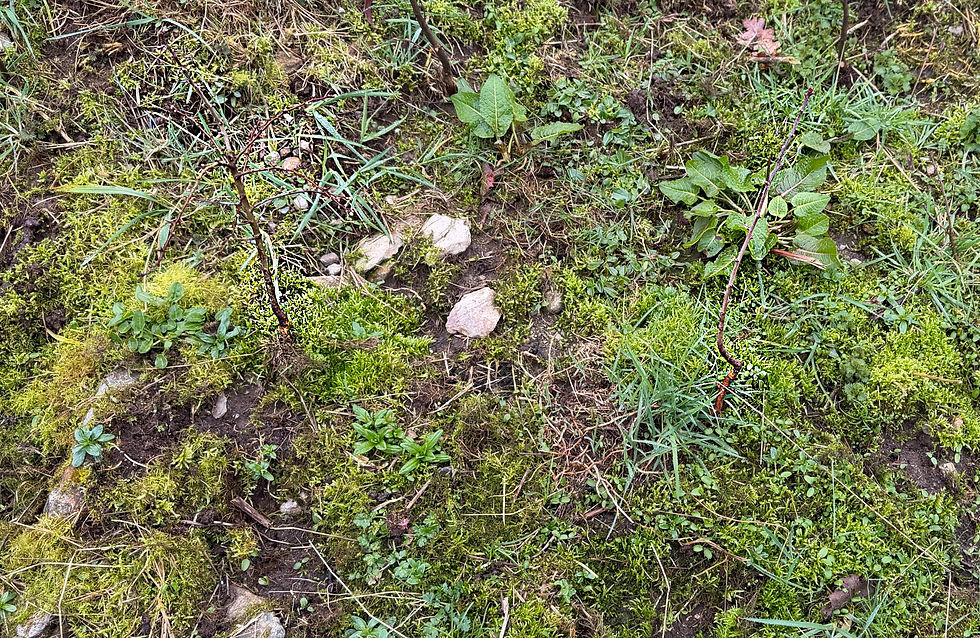
This is also where grass and ground cover matter. Dense vegetation around the base of a young tree, moss especially, gives cover to voles and competes for water. Keeping a small area around the sapling relatively open, sometimes with mulch, sometimes by hand clearance, can greatly improve survival. This work is dull. It wins no photographs. It is nonetheless part of the real business of planting.
Mesh size is important. I use welded mesh tree guards that are 1.8 metres high and have a mesh aperture of 3” x 1”. Animals hate rectangular spaces, and much prefer them to be circular, so a rectangular, small mesh is what I seek. The cage opens from top to bottom to allow access, and there are two stakes. One is on the outside of the cage, to hold the cage in position. I place the stake outside the cage so I can adjust it without disrupting the cage itself. The other stake is inside the cage, supporting the tree. The cage is reinforced by two long, obliquely positioned steel J-pins that skewer it to the ground. Tree protection is an essential part of the planting process.
The long attention
The first years of a tree’s life are decisive. Stakes loosen. Tree ties bite. Guards tilt. Grass thickens. Rabbits arrive. Sheep and deer are everywhere, it seems. A wet winter floods a planting pit. A summer dry spell stresses roots that were never well established. A tree that looked perfectly satisfactory in January looks uncertain by July and dead by the following spring. None of this is mysterious. It is simply what happens when living organisms are introduced into the world and left to negotiate it.
That is why revisiting matters so much. Establishment depends on it.
A planted tree should be checked. Then checked again. And again, and again, and again. A small adjustment made early can save a tree that would otherwise be lost. Re-firming soil after wind rock, resetting a stake, straightening or replacing a guard, clearing vegetation, adding mulch, redigging a swale, fashioning a fresh berm, noticing bark damage early enough to act. These are the types of intervention that separate establishment from abandonment.
Large schemes often struggle here. Planting days are easy to organise. Long-term attention is harder. Funding frequently favours the visible act rather than the maintenance that follows. Volunteers appear for an event. Fewer appear for the third inspection of the same saplings after a wet winter and a spring gale. Yet this further effort is where success lives.
Evidence from establishment studies and reports repeatedly indicates that mortality is concentrated in the early years and that poor planting methods, unsuitable site conditions, and inadequate aftercare are major contributors. None of this is surprising. Young trees are vulnerable. It should change how we talk. Success should not be claimed at planting. It should be judged after survival.

So, I return to the hillside of fallen, supine tubes visible on the far side of the valley from my land. I do not know the details of each failure. I am never likely to know. Perhaps some died from waterlogging, some from browsing, some from wind, some from poor rooting, some from a combination of all four. But the larger lesson is clear enough. Planting without establishment is not restoration. It is an aspiration.
To plant a tree properly is to think beyond the day itself. It is to ask whether the species suits the exact place, whether the soil will breathe, whether water will pass or linger, whether the guard will protect, whether the tree will be revisited, and whether anyone is willing to undertake the unglamorous work ahead, that of establishment. Planting is widely recognised as being worthwhile. Establishment is not. Better to have fewer trees well established than many ceremonially lost.
Years from now the broken tubes on that opposite slope will probably be gone. Wind will fracture them further, they may tumble into the river below, perhaps someone will remove them, or they will simply sink into the rough untidiness of the hillside and vanish. While they exist, they may continue to poison mankind, indeed all living creatures. What will remain, if establishment has succeeded at all, are the trees that survived. Their stems will thicken. Their bark will darken. Moss will creep upward. Birds will perch in their branches. Animals will take shelter, and that includes mankind. From my land, and who knows if I will still be in existence, I trust that by then it will not be possible to see pale plastic scattered through the grass, but instead the darker shapes of young woodland knitting the slope together.

And that, in the end, is the real point. Not the planting day. Not the photograph. Not the number in the report. What I wish to find is that years later, the tree is still there, holding the ground, catching the rain, and entering the long memory of the landscape. I have no wish to see a supine, plastic tree tube.
Rules for planting trees
I adopt ten rules for planting trees and follow them as best I can, whenever I can. The rules are:
1. Choose the right tree for the place.
Match the species to soil, rainfall, exposure, and elevation. A well-adapted species will establish more readily than one placed outside its ecological comfort zone.
2. Examine the soil before planting.
Look at drainage, compaction, and organic matter. If water pools in the hole or the soil is hard to penetrate with a spade, establishment will be difficult unless conditions are improved.
3. Dig wide rather than deep.
Create a planting hole at least twice the width of the root system but no deeper than the root collar. Roots grow sideways far more than downwards.
4. Keep the root collar at ground level.
Do not bury the base of the trunk. The flare where the trunk meets the roots should remain visible at the soil surface.
5. Firm the soil carefully.
Backfill the hole with the original soil and press it down gently but thoroughly. Good root-to-soil contact prevents air pockets and helps water move to the roots.
6. Stabilise the tree without immobilising it.
Use stakes, if necessary, especially in exposed places, but allow some movement of the trunk. Moderate movement encourages stronger roots and stems.
7. Protect the tree from animals.
Install guards or cages that prevent browsing and bark damage. Ensure mesh openings are small enough to exclude rabbits and other small mammals.
8. Reduce grass competition.
Keep the base of the tree clear of dense vegetation for the first few years. Mulch can help conserve moisture and reduce competition for nutrients.
9. Manage water carefully.
Young trees may require watering during dry spells, but they also need drainage. In wet climates, consider small landscape adjustments such as swales or berms to prevent waterlogging.
10. Monitor the tree for several years.
Return regularly to check stakes, guards, cages, and soil conditions. Most failures occur in the first five years, and early attention can prevent small problems from becoming fatal.
A tree that survives its early years rarely requires further assistance. Once its roots have secured themselves in the soil and its crown has risen beyond browsing height, it becomes self-sufficient. At that point, the planter’s work is largely complete, and the landscape has gained a new, long-lived resident.
***
Hashtags
References
[i] Grossnickle SC. Why seedlings survive: importance of plant attributes. New Forests. 2012; 43:711-38.
[ii] Brady NC, Weil RR. The nature and properties of soils. 15th ed. Harlow: Pearson Education; 2017.
[iii] Smith SE, Read DJ. Mycorrhizal symbiosis. Academic Press; 2010 Jul 26.
[iv] Roman LA, Battles JJ, McBride JR. Determinants of establishment survival for residential trees in Sacramento County, California. Landscape Urban Plan. 2014; 129:22-31.
[v] Harris RW, Clark JR, Matheny NP. Arboriculture: integrated management of landscape trees, shrubs, and vines. 4th ed. Upper Saddle River: Prentice Hall; 2004.
[vi] Löf M, Dey DC, Navarro RM, Jacobs DF. Mechanical site preparation for forest restoration. New Forests. 2012 Sep;43(5):825-48.
[vii] Day SD, Bassuk NL. A review of the effects of soil compaction and amelioration treatments on landscape trees. Arboriculture & Urban Forestry (AUF). 1994 Jan 1;20(1):9-17.
[viii] Watson GW, Himelick EB. Principles and practice of planting trees and shrubs. Savoy, IL: International Society of Arboriculture; 1997 Jul.
[ix] Gill RM, Beardall V. The impact of deer on woodlands: the effects of browsing and seed dispersal on vegetation structure and composition. Forestry. 2001 Jan 1;74(3):209-18.
[x] Tuley G. The growth of young oak trees in shelters. Forestry: An International Journal of Forest Research. 1985 Jan 1;58(2):181-95.
[xi] Potter MJ. Treeshelters. London (UK): HM Stationery Office; 1991.
[xii] Crawley MJ. Plant population dynamics. Theoretical ecology: Principles and applications. 2007 Feb 15:62-83.


Comments