How Walkers Affect the Lake District: The Hidden Environmental Cost of Countryside Access

In brief
Millions of people visit the Lake District every year to enjoy its landscapes, wildlife and public footpaths. Most visitors leave with positive memories and little intention of causing harm. Yet walkers, dog owners, runners, cyclists and wild campers can all have significant effects on wildlife, dry stone walls, livestock, peatlands and historic landscapes. This article explores the environmental impact of walkers in the Lake District and asks how public access can be balanced with conservation.
***
Morning discoveries
There is a particular clarity to the land in the early morning. Before the first dog appears over the skyline, before the crunch of boots on stone, before the chatter of walkers carries across the fell. It is then that the countryside reveals what has been done to it.
A wall slightly slumped where it stood firm the day before. A gate hanging awkwardly from one hinge. A path wider than it was last week because walkers have skirted around a patch of mud rather than through it. A crushed beer can hidden in a dry stone wall. A doggy poo bag swinging from a branch.
None of these things is dramatic. No single act demands outrage. Yet together they form a pattern. A slow erosion of landscape, infrastructure, and goodwill. The countryside is rarely damaged by one great act of destruction. More often, it is worn away by countless small acts of convenience.
Access and obligation
The introduction of Open Access land under the Countryside and Rights of Way Act 2000 transformed public access to the countryside.[i] The Right to Roam opened mountains, moors, heaths, and downs to millions of people. It was, and remains, an important achievement. Yet every right carries responsibilities.
Much of the countryside is privately owned and actively managed. Dry stone walls do not repair themselves. Gates do not magically rehang. Eroded paths are not maintained by invisible workers hidden somewhere beyond the next ridge.
Walking in the countryside is therefore a two-way process. Visitors receive access, scenery and experience. In return, the landscape requires care and restraint.
On my own land in the Lake District, walkers frequently stop to admire the view. Many are friendly and curious. Yet it is striking how often people seem surprised to discover that someone owns and manages the land beneath their feet. There is sometimes an assumption that the countryside simply exists, maintained by no one and available to everybody.
The reality is rather different. Only the other week, I found somebody had planted an oak tree in the middle of a footpath. I ask you.
Walls and heritage
Dry stone walls define much of the Lake District. They are so characteristic that many visitors scarcely notice them, despite being among the most remarkable human features in the landscape.
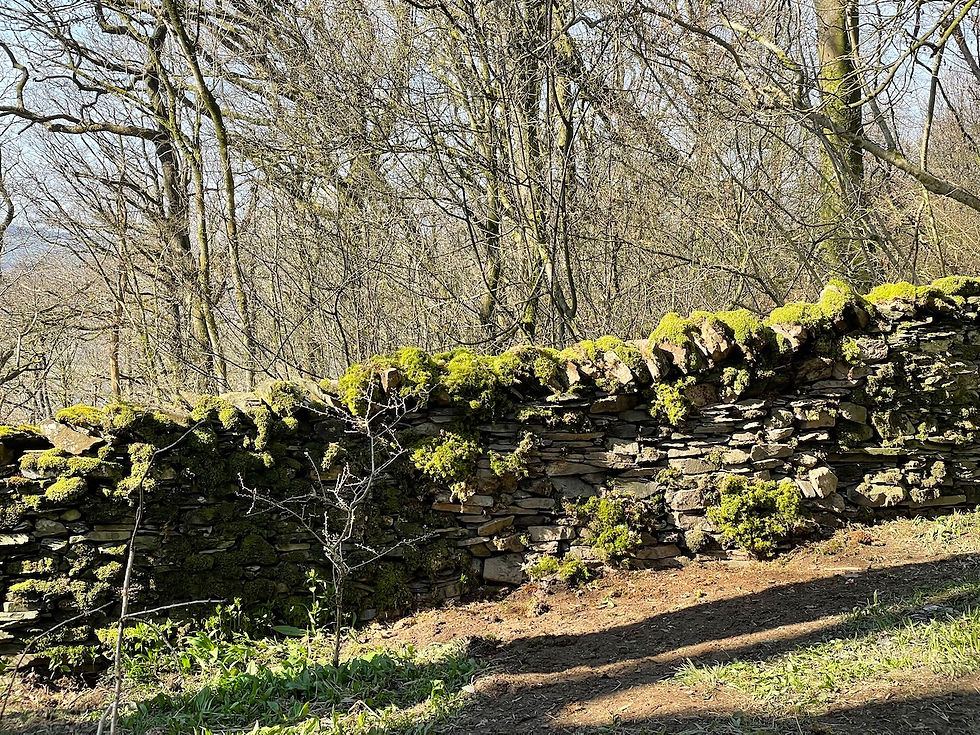
UNESCO has recognised the art of dry stone construction as part of the Intangible Cultural Heritage of Humanity.[ii]These walls represent centuries of accumulated skill. Every stone has a purpose. Every coping stone contributes to the structure's stability. The problem is that visitors often see only loose stone.
I once found a section of boggy path where walkers had thoughtfully created a crossing using flat stones taken from the top of a nearby wall. Their feet remained dry. The wall, stripped of what were actually essential coping stones, later collapsed and required rebuilding. It took me a full day. All because some walkers preferred to avoid muddy feet.
To the walker, moving a stone may seem insignificant. To the wall, it is the beginning of failure. Frost enters. Livestock lean. Gravity takes over.
Walls are also habitats. Their cavities shelter insects, small mammals and reptiles. Their surfaces support mosses and lichens that may have taken decades to establish. When a wall collapses, something more than a boundary is lost.
Gates and boundaries
A gate on a public footpath rarely attracts attention until it fails.
Many failures are accidental. A hinge wears. A latch breaks. A gate is pushed beyond its limits. Increasingly, gates designed for walkers are subjected to the impacts of runners and mountain bikes. The damage is usually incremental. A little more strain here. A little more force there. Eventually the structure gives way.
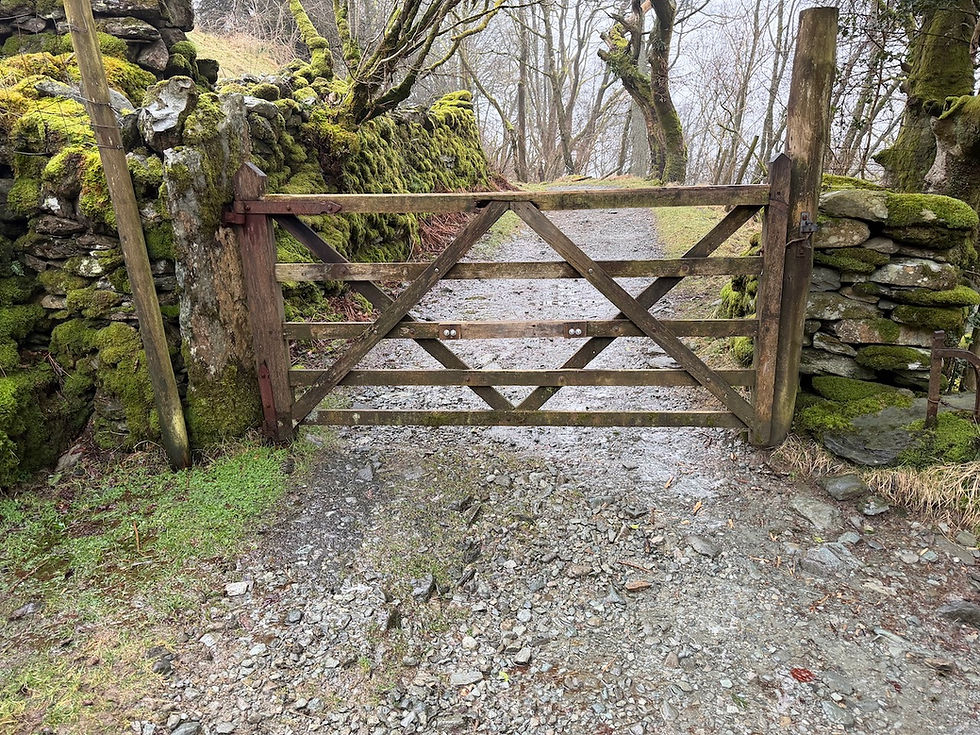
Paths tell a similar story. A wet section is avoided. Then avoided again. Soon a single path becomes two. Then three. Vegetation disappears. Soil compacts. Water follows the disturbed ground and erosion accelerates.
In upland landscapes, recovery can be painfully slow. What begins as a simple attempt to avoid muddy boots may create a scar that remains visible for years.
Why does an open gate matter?
Few things create more anxiety for farmers than a gate left open. To a passing walker it may appear a minor oversight. To a livestock keeper, it can trigger hours or days of work.
Lakeland sheep may wander onto neighbouring land or roads. Highland cattle may move into places where they are not expected. Animals can become separated from their offspring. Flocks can mix. Veterinary problems can follow.
The issue is rarely malicious. More often it arises because visitors do not understand the purpose of a gate. Some leave gates open that were intentionally left closed. Others close gates that have been intentionally left open. Both actions can create problems.
Much of upland Britain still relies on hefted sheep.[iii] These animals learn their traditional grazing areas from older generations and often remain within them without extensive fencing. Once displaced, that system can begin to break down, creating considerable work for shepherds.
The countryside functions through countless small systems that are largely invisible to visitors. Gates are one of them. The old instruction remains sound. Leave gates as you find them.
Missing signs
The disappearance of a countryside sign may seem harmless. In reality, it can create risks for wildlife, livestock and people.
A sign requesting that dogs be placed on leads may have been installed because ground-nesting birds are breeding nearby. It may be lambing season. Highland cattle with calves may be grazing in the next field. Remove the sign and the context disappears with it.

The visitor who later allows a dog to run free may have no idea that a problem exists.
Ground-nesting birds are particularly vulnerable. Skylarks, meadow pipits, curlews, lapwings and woodcock all nest on or close to the ground. Their nests are often almost invisible. A walker may pass within a metre of one without noticing. A single disturbance may not matter. Repeated disturbances can lead to nest abandonment and breeding failure.
Wildlife adapts remarkably well to human presence, but adaptation has limits. The cumulative effects of repeated disturbance are often invisible to those causing them.
That invisibility may be one of the greatest conservation challenges facing the modern countryside.
How do dogs affect wildlife?
Dogs occupy a curious position in the countryside. They are beloved companions, welcome on many paths and fells, and often one of the reasons people venture outdoors in the first place. Yet to wildlife they are rarely viewed as companions. They are perceived as predators.
On my own land, wildlife often appears surprisingly tolerant of human presence. Roe deer browse quietly among the trees. Badgers emerge from their setts after dark. Redstarts and willow warblers continue to sing as walkers pass below. It would be easy to conclude that people have little effect. The reality is more complicated.
Wildlife frequently adapts to predictable disturbance, but adaptation is not the same as absence of impact. Animals alter their behaviour. Birds spend less time feeding and more time remaining alert. Mammals avoid otherwise suitable habitat near busy paths. Ground-nesting birds may abandon territories altogether if disturbance becomes too frequent. The Lake District contains several species particularly vulnerable to recreational pressure.

A dog running freely across open fell presents a different challenge. Even if no physical contact occurs, the nesting bird may be flushed repeatedly from its eggs or chicks. Exposure to predators, cold weather or overheating can follow.
Research has demonstrated that dog walking can significantly reduce bird abundance and diversity in natural habitats.[iv]More recent studies have shown that dogs walked off lead disturb substantially larger areas than those kept under close control.[v]
Livestock worrying
The same principle applies to livestock.
Many dog owners insist that their animals would never attack sheep. In most cases they are probably correct. The problem is that direct attack is not the only concern. Livestock worrying includes chasing, pursuing and causing stress.[vi] Sheep may run considerable distances, become separated from lambs, collide with walls or fences, or miscarry days later. The consequences can be severe even when the dog never lays a tooth on an animal.
The scale of the problem is considerable. Livestock worth an estimated £2.4 million were severely injured or killed by dogs in 2023, an increase of almost 30 per cent on the previous year.[vii] The true figure is almost certainly higher because many incidents go unreported.

The economic consequences can be significant. Hill farming rarely generates large profits. A handful of lost breeding ewes may represent a substantial proportion of a farm's annual income. The emotional impact can be equally profound. Many farmers know their bloodlines and breeding stock intimately. Discovering injured or dead animals is not merely a financial loss. It is tempting to dismiss such concerns as agricultural sensitivities. They are not. They are practical realities.
A lead clipped onto a dog during lambing season may prevent hours of suffering and thousands of pounds of losses.
The poo bag paradox
Few objects better symbolise modern countryside access than the doggy poo bag. The process begins responsibly enough. A dog fouls the path. The owner collects the waste. The bag is tied neatly and removed from the ground. Then something strange happens.
The bag appears beside a wall. Or in the bracken. Or hanging from a tree branch as though it were some curious woodland ornament. I have never understood the logic. Perhaps the owner intends to retrieve it later. Perhaps they forget. Perhaps carrying a warm bag of dog waste for several hours proves less appealing in practice than in theory. Whatever the explanation, the result is the same. A problem that was briefly solved becomes a different problem altogether.
The environmental irony is considerable. Uncollected dog waste introduces pathogens and excess nutrients into sensitive habitats. Yet once wrapped in plastic and abandoned, the waste remains while the plastic may persist for years.[viii] The countryside does not possess an invisible cleaning service. Someone eventually removes these bags.

The contrast between responsible and irresponsible behaviour is striking. The owner who quietly carries a bag home receives no praise. The abandoned bag is seen by everyone.
Perhaps that is the nature of good behaviour. It often passes unnoticed. It is hardly ever praised.
Litter's long life
Dog waste is only one form of litter. Beer cans, plastic bottles, food wrappers, disposable barbecues and wet wipes all find their way into the countryside. Some arrive by accident. Others appear to have been discarded deliberately.
A crushed can hidden in a dry stone wall may remain there for decades. Plastic fragments slowly break down into smaller pieces rather than disappearing. Wet wipes, despite marketing claims, often persist in the environment long after their users have gone. I have developed a thing about wet wipes.

The cumulative effect is subtle but significant. Landscapes valued for their natural beauty acquire an increasingly artificial character. Visitors often express disappointment when they encounter litter.
“Who did that?” they ask, pointing with disapproval.
Yet few stop to consider that somebody must remove it. They walk on, leaving the tidying to muggins.
The quiet violence
Walking seems innocuous because each individual footstep is harmless. The problem lies in repetition. A thousand footsteps begin to change the ground. A million reshape it. Soil becomes compacted. Water infiltration declines. Surface runoff increases. Paths widen. Vegetation struggles to recover. In steep terrain, erosion accelerates.
The effects are particularly noticeable in upland environments where soils are often thin and fragile. Recovery may take years. In some locations, it may never fully occur.
There is a paradox at work. People visit wild places because they value natural landscapes. Yet the cumulative impact of those visits can gradually diminish the qualities they have come to enjoy.

One walker crossing a muddy patch causes no obvious damage. Ten thousand walkers crossing the same patch each year create a different outcome entirely. The environmental challenge facing the Lake District is rarely individual behaviour. It is cumulative behaviour. Actions that appear insignificant when undertaken once become consequential when repeated millions of times.
How do walkers affect peatlands?
Some consequences are less obvious than others. Compacted paths become channels. Rainwater follows them, accelerating erosion and redistributing soil. Small streams alter course. Drainage patterns change. Peatlands are especially vulnerable.
The Lake District contains thousands of hectares of peat habitat, storing huge quantities of carbon accumulated over millennia.[ix] Some of that peat lies on my own land. The vegetation covering it acts as a protective layer. Once damaged, the peat beneath becomes vulnerable to drying and erosion.
Damage to peatlands is not simply a local issue. Peat stores large quantities of carbon accumulated over thousands of years. When damaged through erosion, trampling or fire, peat can release stored carbon into the atmosphere, linking local recreational impacts to wider climate change concerns. What was previously a carbon store can begin releasing carbon back into the atmosphere.
Wildlife retreats
The countryside is not empty. It is occupied by creatures that have evolved to survive within surprisingly narrow margins.
One lesson I learned during the Covid-19 lockdowns was how quickly wildlife responds when human pressure decreases. The change was remarkable. Footfall dropped dramatically. Disturbance reduced. Animals appeared in places where they had previously been scarce.
The return was not universal, nor was it permanent, but it was noticeable enough to provoke reflection. We often assume that wildlife simply adapts to our presence. Sometimes it does. Sometimes it merely tolerates us because it has no alternative.
How do walkers affect wildlife?
The effects of walkers on wildlife are often subtle and therefore easy to overlook. Unlike litter, erosion, or a broken wall, wildlife disturbance frequently leaves no obvious trace. The walker sees only a bird flying away or a deer disappearing into woodland. What happens afterwards is usually invisible.

Mountain bikes present a particular challenge because they can travel faster than walkers and exert greater forces on paths, gates and drainage features. Most riders behave responsibly, but where bikes leave established routes, erosion can accelerate rapidly, especially on steep or wet ground.
Ground-nesting birds are among the most vulnerable species in the Lake District. Skylarks, meadow pipits, curlews, lapwings and woodcock frequently place their nests directly on the ground, often in locations that appear unremarkable to visitors. A single disturbance may have little consequence, but repeated disturbance can cause birds to abandon nests, leave eggs exposed to predators, or spend less time feeding and caring for their young.
Dogs can amplify this problem. Even friendly and well-behaved dogs may be perceived by wildlife as predators. Research has shown that dog walking can reduce bird abundance and diversity in natural habitats, particularly where dogs are allowed to roam off lead. A nesting bird flushed repeatedly by a dog may ultimately fail to breed successfully, despite never being physically harmed.
Mammals are also affected. Roe deer, which are common on my own land, may avoid otherwise suitable feeding areas near busy paths and tracks. Badgers can delay emergence from their setts when disturbance becomes frequent. Small mammals may become more exposed to predators where vegetation has been trampled, or habitat fragmented.
The remarkable thing about wildlife is its ability to adapt. Yet adaptation is not the same as absence of impact. Animals often alter their behaviour simply to accommodate our presence. The challenge is that these changes are rarely visible to those causing them.
The countryside may appear unchanged after a walker has passed through. For the wildlife that lives there, however, the effects may last considerably longer.
Does wild camping damage the countryside?
Wild camping occupies an uncertain place in England. Unlike Scotland, where responsible wild camping is broadly permitted, most of England provides no general right to camp on Open Access land.[x] Yet wild camping continues, often quietly and without incident.

Done well, it leaves little trace. A small tent pitched late. No fire. No litter. A departure early the following morning. Done badly, it leaves scars.
On the Lake District fells I have encountered fire circles where none previously existed, scorched vegetation, discarded cans, abandoned equipment, wet wipes, food packaging and poorly buried human waste. The evidence often remains long after the camper has disappeared.
Fire presents the greatest risk. Peat soils can smoulder beneath the surface, creating damage that may continue unseen for days or weeks. Disposable barbecues are particularly problematic. A few moments of convenience can create years of environmental harm.
The difference between good and bad wild camping is not complicated. It is largely a matter of understanding and respect. Unfortunately, not everyone arrives with either.
History beneath our feet
The countryside contains countless features that escape casual notice. A slight earthwork. A line of stones. A level platform beside a wall. To most walkers they appear unremarkable. To historians and archaeologists, they may represent centuries of human activity.
My own land contains evidence of former settlements, charcoal burning, quarrying and ancient farming. Human communities almost certainly occupied parts of it long before modern footpaths existed. Their traces survive in subtle ways. When landscape features are altered, those traces can be lost.

A stone removed from a wall may once have formed part of a historic boundary. A camping area may overlie an archaeological feature. An apparently empty clearing may hold evidence of past lives and livelihoods.
The countryside is not merely scenery. It is a historical document written across the landscape itself.
Unintended consequences
Not all damage is deliberate. One morning I discovered an oak sapling planted beside a public footpath. Someone had clearly intended to improve the landscape. The young tree was protected by a plastic guard and appeared healthy. The problem was its location.
If it survives, the tree will eventually obstruct the path. Either the path will need diverting, or the tree will require moving. The issue may not arise for many years, but it illustrates an important point. Good intentions are not always sufficient.
The countryside functions as a system. Altering one element often creates consequences elsewhere.
Invisible travellers
Some impacts cannot be seen at all. Seeds cling to boots, clothing and dogs' coats. Plant diseases move within soil attached to footwear. Invasive species spread unnoticed from one valley to another. Visitors rarely realise they are transporting anything. Yet ecological change frequently begins in precisely this way.
Woodlands, rivers and peatlands already face numerous pressures. The accidental introduction of invasive plants or pathogens adds another layer of complexity.
The consequences may not become apparent for years.
Sound and silence
There is another form of disturbance that leaves no physical trace - noise.
The countryside possesses its own soundscape. Wind moving through trees. Water flowing over stone. Birdsong carried across a valley. Human noise changes that character. Loud conversations, amplified music, and drones can transform the atmosphere of an otherwise quiet landscape. Wildlife notices. So do people.
Among the more recent additions to the countryside is the recreational drone. They are useful devices and often produce remarkable imagery. They can also disturb both wildlife and visitors seeking tranquillity.
Silence is one of the countryside's most valuable resources. Once lost, it is difficult to restore.
The repair burden
Every damaged wall, blocked drain, broken gate and abandoned bag creates work. Somebody must clear the litter. Somebody must rebuild the wall. Somebody must repair the erosion.

On my own land I recently spent several days restoring drainage damaged by repeated foot traffic. Few walkers will ever know that work took place. Fewer still will recognise why it was necessary. That invisibility is part of the problem.
Visitors see the finished landscape. They rarely see the effort required to keep it functioning.
The burden falls on landowners, farmers, volunteers, and conservation organisations. Most accept that responsibility willingly. Frustration arises only when people repeatedly cause damage and never notice the consequences.
A two-way process
None of this is an argument against public access. The Right to Roam remains one of the most important developments in modern countryside policy. Open Access land allows millions of people to experience landscapes that might otherwise remain beyond their reach.
The benefits are enormous. Physical health improves. Mental wellbeing improves. Understanding of nature improves. The challenge is not access itself. The challenge is behaviour.
However, the Right to Roam was never intended as a one-way entitlement. It is an unwritten agreement. The land provides access. Visitors provide care. That care may be as simple as remaining on a path, keeping a dog under control, carrying litter home, or leaving a gate exactly as it was found. Small actions matter because they are repeated millions of times.
Leave it better
Conservationists often repeat a familiar phrase.
“Leave nothing but footprints. Take nothing but photographs.”

It remains good advice, but perhaps modern pressures require something more. In heavily visited landscapes, neutrality may no longer be enough. A better ambition is to leave a place slightly better than it was found.
Pick up a piece of litter. Close a gate properly. Respect a sign. Keep a dog on a lead where requested. None of these actions is difficult. Collectively they make an enormous difference.
The land remembers
The countryside records everything. Not in words, but in form.
A wall leaning slightly downhill. A widened path crossing a patch of fell. A fire scar on peat. A plastic bag caught in a thorn bush. A doggy poo bag swinging from a branch.
These are the notes that people leave behind. Some are accidental. Some are careless. A few are deliberate. All tell a story.
As I walk across my own land in the Lake District, I often find myself reading those stories. Most are disappointing. A few are encouraging. The best are the ones that leave no trace at all.
The future of Open Access and the Right to Roam depends not on legislation, but on behaviour. Access brings privilege, but privilege brings responsibility.
The countryside gives us far more than scenery. It provides wildlife, history, solitude, beauty and perspective.
The least we can do is return the favour.
In summary
The environmental impact of walkers is rarely dramatic. More often it consists of small actions repeated many thousands of times. Path erosion, wildlife disturbance, litter, livestock worrying, damaged dry stone walls and degraded peatlands are often unintended consequences of recreation. Open Access and the Right to Roam remain important achievements, but they depend upon visitors recognising that access carries responsibilities as well as freedoms.
***
Hashtags
***
Frequently Asked Questions
Do walkers damage the countryside?
Yes. Path erosion, wildlife disturbance, litter and damage to infrastructure can occur when visitor numbers are high.
Do dogs affect wildlife?
Yes. Dogs can disturb ground-nesting birds, deer and other wildlife, particularly when off lead.
Why should gates be left as found?
Because livestock management depends on gates being in the correct position.
Does wild camping damage the Lake District?
Responsible wild camping leaves little trace, but poor practice can damage habitats and peatlands.
***
References
[i] legislation.gov.uk.C ountryside and Rights of Way Act 2000. See https://www.legislation.gov.uk/ukpga/2000/37/contents. Accessed 3 June 2026.
[ii] UNESCO. Art of dry stone construction, knowledge and techniques. See https://ich.unesco.org/en/RL/art-of-dry-stone-construction-knowledge-and-techniques-02106. Accessed 1 June 2026.
[iii] National Sheep Association (NSA). The complementary role of sheep in upland and hill areas. See https://nationalsheep.org.uk/assets/documents/02649-lfa-report-digital.pdf?v=1714907364. Accessed 3 June 2026.
[iv] Banks PB, Bryant JV. Four-legged friend or foe? Dog walking displaces native birds from natural areas. Biology letters. 2007 Dec 22;3(6):611-3.
[v] Thomas RL, Papworth SK, Fellowes MDE. Unleashed: walking dogs off the lead greatly increases habitat disturbance in UK lowland heathlands. Urban Ecosystems. 2024;27(6):2037-46.
[vi] National Farmers’ Union. Livestock Worrying by Dogs Survey Results. Stoneleigh: NFU; 2023.
[vii] NFU Mutual. See https://www.nfumutual.co.uk/media-centre/complacency-kills-as-uk-cost-of-livestock-worrying-rises-by-nearly-30/. Accessed 1 June 2026.
[viii] Napper IE, Thompson RC. Environmental deterioration of biodegradable, oxo-biodegradable, compostable, and conventional plastic carrier bags in the sea, soil, and open-air over a 3-year period. Environmental science & technology. 2019 Apr 28;53(9):4775-83.
[ix] IUCN. See https://www.iucn-uk-peatlandprogramme.org/news/collection-three-natural-england-reports-marks-step-change-english-peatlands. Accessed 3 June 2026
[x] legislation.gov.uk. Land Reform (Scotland) Act 2003. See https://www.legislation.gov.uk/asp/2003/2/contents. Accessed 3 June 2026.


Comments